Showing posts with label health. Show all posts

Wednesday, July 21, 2010

The Uniform and Command Presence, A RANT!


First, I don't mean any disrespect to anyone.
With that said, I do think that public image in the uniform is important. I have had civilians come up to me on numerous occasions asking why there is obviously no "physical fitness requirements to stay in law enforcement"?


That is a hard question to answer, because most people know to get into LE, and make it through most academies, you need to be in some kind of shape. The common question is why doesn't this continue? If the public see this, then administrators must see it also. Right?

Yes and no. The problem with making department wide fitness requirements is no one can be exempt. That means, big boy sitting at the top as to comply. Not a big deal, but what if he doesn't? What if the patrol guy doesn't? Are you going to let someone use a medical exemption for a "fitness" requirement? If they can't maintain a basic amount of fitness, can they do the job? Sounds like someone might get sued.

The truth is, Americans are overweight, so cops are overweight. The choice has to be the officers, you have to do it yourself.

KNOW THIS; THE PUBLIC SEES IT, THEY RESPOND TO IT, IT EFFECTS YOUR ABILITY TO DO YOUR JOB! IT TAKES AWAY YOUR COMMAND PRESENCE IT PUTS YOUR SAFETY AT RISK!


While I'm on the soap box: If your a "big boy" and think that extra 150 lbs your carrying around makes you a badass and intimidates the bad guy, your wrong! If your out of breath after you walk up a flight of stairs or up to a violator's vehicle, then you have displayed how weak you are. You have left yourself open to resistance, whether it be verbal, mental or physical.

Get in shape!

Monday, May 31, 2010

Change Things UP!


SUPERSETS/CARDIO/TREADMILL/BIKE/JOG/GROUP CLASSES/HEAVY LIFTING/HIGH REPS/LOW REPS/NEGATIVES/SLOW REPS/SPORTS/SWIM/HIKE/YOGA/BOXING/ETC.


You have to mix up your program if you want to see results, avoid injury and keep your body burning calories at its max.


Change your program up every 4 weeks at least and any day that you need a change make it.


BURN MORE CALORIES/BUST PLATEAU/REACH FULL GROWTH POTENTIAL/INCREASE ENDURANCE/STAY MOTIVATED/HAVE FUN/GET CUT


BE YOUR BEST


Sunday, February 14, 2010

Supplements?

I am often asked what supplements do I take, or what do I recommend?

Supplements are a difficult subject to talk about. If you read any kind of "Muscle and Fiction" mag or spend anytime looking online you will find 1000s of supplements that promise the world and even have "studies" and "research" with graphs and pictures.


One thing is for certain: If there was a pill to make you lose fat, then every woman in America would be taking it or would have taken it. If there was a pill to build muscle (that was safe and legal), then every man in America would be taking it or would have tried it.

My first recommendation would be to check with your doctor before taking any supplements. Most doctors will recommend a daily multi-vitamin and maybe a few other items, but not much else. Medicine in the U.S. is proactive, it does not focus on prevention or nutrition. You might have a doctor that will say something like, "you should cut down on the fried foods" or something to that effect, but to really discus your diet and how it effects your health with your physician is rare. In other countries it's not like that. Medicine is more proactive, you can't deny that diet, nutrition and genetics is important, and it makes sense to look at it. It's like taking your car to a mechanic and not discussing the fact that you never change the oil or that you have used bad gas.


The Basics:

  • Multi-Vitamin-look for a "Men's" version if your male and "Woman's" if your not. I take One A Day Men's.

  • Joint Supplement-containing Glucosamine and Chondroitin. I have used several brands, always looking at the labels to make sure they contain high enough doses of the desired ingredients. I am currently taking a product called "Move Free Advanced Triple Strength". I have noticed a decrease in shoulder and knee pain since supplementing with this type of product.

  • Omega-3 Fish Oil- Look for enteric coated to prevent "fish burps". I take a capsule from Sam's that is enteric coated and double strength so only one per day is needed, just makes it easier. If you have certain risk factors for heart disease there is a prescription version of this supplement, ask your doctor. Lots of research out there about supplementing with fish oil, it's the vitamin of the new age.

Beyond Basic:

  • Antioxidants- I take ECGC a green tea extract, Grape Seed Extract and an occasional extra Vitamin C. I won't go into it here, but spend a few minutes researching some of these antioxidants and others and make your own choice. To me extra antioxidants make good sense.

  • BCAA-Branch Chain Amino Acids-During heavy training routines I take a BCAA supplement in a drink mix. There is a ton of research out there about how these aminos can help you rebuild after training. My real world results are mixed, but I have used them for years and can tell (real or not) when I don't have them.
  • Protein- A quality Whey Protein may be useful if you are on a calorie restrictive diet, or if you are trying to eat 5-6 meals a day, a low calorie smoothie with some whey is a easy fix. I am hit or miss when it comes to supplementing with protein, currently I'm taking a scoop (25grams) of whey with a diet juice drink in place of a regular snack. Don't take more than 30 grams in a single serving.
  • Extra Vitamin D3-The FDA has suggested doubling the RDA of Vit D. If you work nights or use sunscreen or don't get enough dark green leafy vegetables you may need an extra 400 IUs to 800 IUs of Vitamin D3. Research is showing it may effect your body in multiple ways including preventing cancer and benefiting heart health. It is a different class of supplement, unlike most other vitamins, it is a hormone. Make sure it is the "D3" version.


Wednesday, December 31, 2008

Second Hand Smoke


Smoking ban leads to major drop in heart attacks
By MIKE STOBBE, AP Medical Writer Mike Stobbe, Ap Medical Writer – Wed Dec 31, 6:06 pm ET
ATLANTA – A smoking ban in one Colorado city led to a dramatic drop in heart attack hospitalizations within three years, a sign of just how serious a health threat secondhand smoke is, government researchers said Wednesday. The study, the longest-running of its kind, showed the rate of hospitalized cases dropped 41 percent in the three years after the ban of workplace smoking in Pueblo, Colo., took effect. There was no such drop in two neighboring areas, and researchers believe it's a clear sign the ban was responsible.
The study suggests that secondhand smoke may be a terrible and under-recognized cause of heart attack deaths in this country, said one of its authors, Terry Pechacek of the U.S. Centers for Disease Control and Prevention.
At least eight earlier studies have linked smoking bans to decreased heart attacks, but none ran as long as three years. The new study looked at heart attack hospitalizations for three years following the July 1, 2003 enactment of Pueblo's ban, and found declines as great or greater than those in earlier research.
"This study is very dramatic," said Dr. Michael Thun, a researcher with the American Cancer Society.
"This is now the ninth study, so it is clear that smoke-free laws are one of the most effective and cost-effective to reduce heart attacks," said Thun, who was not involved in the CDC study released Thursday.
Smoking bans are designed not only to cut smoking rates but also to reduce secondhand tobacco smoke. It is a widely recognized cause of lung cancer, but its effect on heart disease can be more immediate. It not only damages the lining of blood vessels, but also increases the kind of blood clotting that leads to heart attacks. Reducing exposure to smoke can quickly cut the risk of clotting, some experts said.
"You remove the final one or two links in the chain" of events leading to a heart attack, Thun said.
Secondhand smoke causes an estimated 46,000 heart disease deaths and about 3,000 lung cancer deaths among nonsmokers each year, according to statistics cited by the CDC.

Read more on this article here.click

Tuesday, September 30, 2008

Cardiovascular Disease CVD

CVD
CVD is a general term for diseases that affect the heart and or circulatory system, and is the leading cause of death in the U.S. for both men and women, approximately 1 million deaths annually.
Coronary Artery Disease CAD is a common form of CVD. CAD is the buildup of fatty plaque in the coronary arteries, which are located within the heart muscle. This buildup can cause a restriction of blood flow to the heart and if a blockage occurs a heart attack results. Approximately 1.1 million heart attacks occur annually in the United States, with over 90% of these occurring at rest. Heart attacks account for 52% of all CVD deaths.
It is important to be able to recognize the "7 Major (primary) risk Factors for CAD", most importantly it is important to realize that, all but one of these risk factors are completely avoidable for most individuals.
7 Major Risk Factors for CAD
1) Abnormal Blood Cholesterol Level
2) Hypertension
3) Smoking
4) Diabetes/Prediabetes
5) Family History
6) Sedentary Lifestyle
7) Obesity
It is important to get a yearly checkup complete with blood work. Check with your doctor about these risk factors and make a change. It could save your life.
-some information taken from the Cooper Institute manual '08

Friday, September 26, 2008

10 Muscle Facts

DID YOU KNOW

1.The human body has more than 650 muscles.

2.Skeletal muscle is the body's largest tissue, accounting for approximately 45% of body weight in men and 36% in women.

3.Muscle fibers are thinner than a human hair and can support up 1,000 times its own weight.

4.There are three types of muscles in the human body: skeletal, smooth and cardiac.

5.Muscles are efficient. They normally use about 35-50 percent of their potential energy.

6.By the age of 65, individuals who haven't engaged in strength/exercise programs on a regular basis may incur a decrease in muscular strength by as much as 80%.

7.Approximately 70-75% of skeletal muscle is water, 20-25% is protein.

8.Muscle soreness is a result of microscopic trauma of tissue and not due to lactic acid.

9.By the age of 80, sedentary individuals will lose about 50% of their muscle mass.

10.People who strength train with a partner have more success and better results.


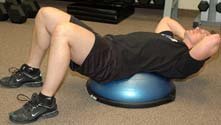
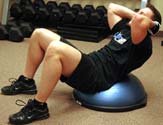
I'm going to have to buy on of these!


Another effective use for this new toy I mean tool. I have looked at them online and surpised to find out they are pricey at $99-$129.


Crunch


The basic crunch is performed by lying with your back on the ball, and your feet flat on the ground. Then proceed to complete a crunching motion, and return to the initial position. The ball will allow you to get a greater range of motion for your abdominals. Complete at least 3 set of 30 crunches, or as many as you can do.

Sunday, August 31, 2008

Do you have an abnormal blood cholesterol level?

Only a blood test/screening can determine your cholesterol level.
1/3 to 1/2 of all Americans have abnormal blood cholesterol levels; only a small percentage of these individuals are taking medications to improve their cholesterol.
Cholesterol is produced by the liver and obtained in the diet.

High density lipoprotein (HDL) is know as the "good" cholesterol, low density lipoprotein (LDL) is know as the "bad" cholesterol.
Total cholestrol of 200 or less is considered ideal for most people. LDL is considered optimal below 100 and a LDL of 160 is high. A HDL value of less than 40 may be considered low and a risk factor for heart disease. HDL of over 60 may offer protection against HD.

Genetics, diet, physical activity level, %body fat and distribution, stress, age, gender and unknown factors determine blood cholesterol levels.


Lifestyle Factors That Decrease LDL Cholesterol
*increase physical activity level
*decrease dietary saturated and hydrogenated fat
*decrease dietary cholesterol
*increase dietary soluble fiber and soy
*decrease percent body fat
*manage stress effectively
*control diabetes

Lifestyle Factors that Increase HDL
*increase physical activity level
*increase percent body fat
*quit smoking
*decrease blood triglyceride levels
*increase mono and polyunsaturated fat intake
*reduce simple and refined carbohydrates

Consult the following links for more information: http://www.americanheart.org/. http://www.eatright.org/, http://www.cancer.org/
some of the above information provided by The Cooper Institute, Dallas, TX,'05